The Reckoning: A European Strategy For an Unstable World
European Reckoning – Part 1: The Search for a Stable Orbit and the Mathematics of Human Survival
Part 1: The Search for a Stable Orbit and the Mathematics of Human Survival
The fourth article in the European Reckoning series. Following on from:
The Rape of Europa: Sovereignty, Security & The Ethical Tech Opportunity
Overview
The era of American security guarantees, which formed the bedrock of European stability since WW2, has transitioned into a “three-body problem” of unstable unpredictable gravitational interactions between Washington, Beijing, and Brussels. The war in Ukraine has accelerated Russian decline and it has been drawn closer to the Chinese geopolitical mass.
To survive a bipolar world, Europe must achieve escape velocity —the accumulation of sufficient institutional mass and decision-making acceleration to exit the orbit of the two resolving superpowers (China and the USA) and occupy a sovereign Lagrange Point in the global order. This article in 3 parts breaks this down and suggests a path for creating European stability and security and ultimately to create a European force for good in the world.
In addition to accelerating monetary, military and technological autonomy, the Brussels Effect –the mechanism by which EU rules become de facto global standards– must be weaponised as a strategic instrument rather than used just as a consumer protection tool.
Europe must no longer allow foreign sponsored threats to its stability and agency, it must learn to aggressively defend its interests, standards and institutions against the USA, Russia and China. To do so it must learn from Chinese history.
You can read the previous (somewhat more polemical!) articles here:
Europe Is On The Menu (February 2025),
The Union of Europe is Finally Born (March 2025),
The Rape of Europa (October 2025).
- Overview
- Introduction
- Previous Articles on the European Malaise
- Europe Is Still Shell-Shocked
- The Existential Stakes
- The Physics of Stability
- Footnotes
“Since the fall of the Berlin Wall, Europe has no longer been strategically important for the US. The Balkans conflict masked this change. The main objective of US foreign policy is to break up Europe.” 1
(Chirac, 2003)
Plus ça change, plus c’est la même chose.
 AI generated image
Introduction
It is 1971. China is poorer on a per capita basis than most of sub-Saharan Africa. Its military is inferior to both superpowers by every measure. It is internationally isolated, diplomatically marginalised. By every conventional strategic analysis it is a minor power with limited options. It had just emerged from the Cultural Revolution, which killed over one million people and systematically destroyed its intellectual class and industrial managers as well as its foreign policy apparatus. It had been expelled from the United Nations in favour of Taiwan. It had no significant trading relationships with the West. Its military, while large, was technologically primitive compared to either superpower.
In October 1971, the United States performed one of the most audacious acts of strategic repositioning in modern history.2 Henry Kissinger secretly flew to Beijing. Washington had spent twenty years treating Communist China as an existential enemy. In a matter of months, it became a tacit partner — not because China had changed, not because America had changed its values, but because the strategic geometry had shifted. Nixon and Kissinger understood something that most Western governments still struggle to accept: in a multipolar world, leverage belongs not to the strongest player, but to the most pivotally positioned one. Power, at the highest level, is a function of where you stand , not merely what you have. The US sought to use a realigned relationship with China to upset the Cold Warn balance of power.
At the time, the Soviet Union maintained approximately 45 divisions — over a million troops — along its Chinese border following the 1969 Sino-Soviet border clashes. The Soviets were genuinely afraid of a scenario in which a hostile China aligned with American technology, capital, and strategic support.
This produced the extraordinary situation where both superpowers simultaneously competed for the alignment of a country that was a fraction of either’s economic and military power. The leverage was not generated by anything China did or offered. It was generated by each superpower’s fear of what the other superpower might gain from Chinese alignment. Within a decade, China has extracted from both the price of a commitment it never actually made. The leverage came entirely from the credible uncertainty about which way it might tilt.
Europe in 2026 has a larger economy than China did in 1971. A more sophisticated regulatory architecture. A more developed institutional framework. Better technology, better infrastructure, better normative capital. And it has spent over thirty years signalling its alignment to the US so clearly that neither Washington nor Beijing has really needed to compete for its support. That was a dreadful error, as all in Europe can see.
On this journey we need to re-assess whether a revised reset relationship with Russia (post-Putin) is in European and Russian interests and what that might look like whilst we preserve Ukrainian and European integrity and sovereignty.
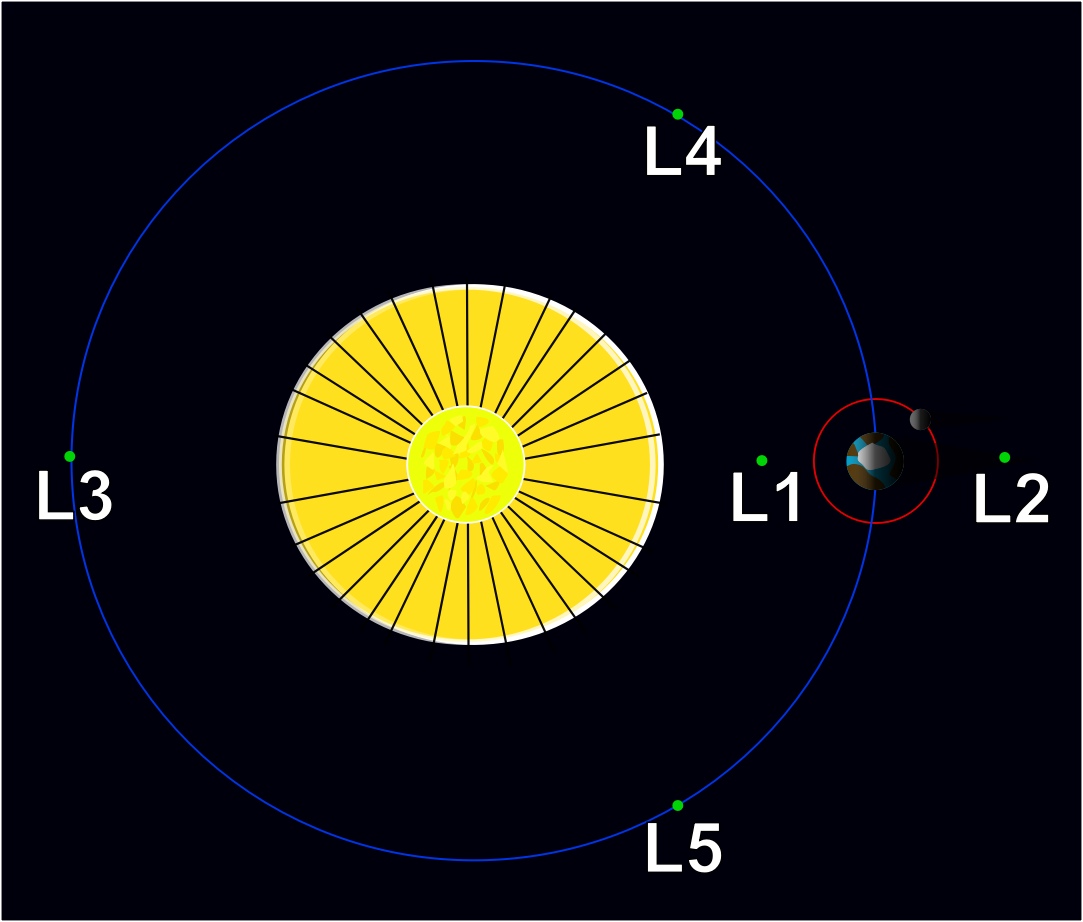
This article is also about the physics of stability. The _Lagrange point_3 is the specific stable position available to a less weighty body between two dominant ones, and it requires diplomatic subtlety, strategic discipline and a foreign policy of credible ambiguity. The current moment is perhaps the last available window for Europe to occupy a strong stable orbit before the US-China binary system fully locks. I also ask what planetary boundary science adds to these calculations for all of us (not just Europeans).
 By Xander89 - File:Lagrange_points2.svg, CC BY 3.0, https://commons.wikimedia.org/w/index.php?curid=36697081
In my view, European strategic autonomy is not merely regional self-interest but a precondition for the global governance architecture the planet requires to remain habitable. The world requires a stable federation of governments, and Europe is the leader in overcoming its violent history to successfully (more or less) manage such a diverse structure of different cultures. China is moving in the other direction with its crackdown on cultural diversity (or should I say promotion of ethnic unity?).4
From the 1970’s onwards China found its Lagrange stability from a position of comparative weakness. Europe has never tried to have its own clear foreign policy, but it can do it from a position of comparative genuine strength and in doing so it will create opportunities for economic growth in the space between today’s superpowers and it can coordinate a safer world for other countries.
Previous Articles on the European Malaise
In February 2025, I wrote that ‘Europe is on the menu’. The face eating leopards were in the room and the masks were off. NATO had long been a Trojan Horse – US defence for Europe was more of a shackle than a shield and this dependency architecture had been deliberately built by the US to perpetuate itself. US foreign policy for decades has been to keep Europe weak and dependent on it. Trump’s demand for European rearmament was only designed to flow to American companies rather than to build European independence and strength (including to defend itself against Russian aggression). I suggested we headed towards a brutal world of superpowers as imagined by Orwell — barely distinguishable oligarchic protection rackets maintaining power through managed conflict.
In March 2025, I argued that the galvanising shock of watching Zelenskyy humiliated by “mafia thugs — terrorists in suits” in the Oval Office might be the moment Europe finally woke from its deep geopolitical sleep. I called for urgent European-Chinese realignment and argued that empathy (the ability to perceive, experience or share in the interests of others - to walk in their shoes for a moon) also has strategic ROI. I warned about the dearth of game theory-based strategy from our largely ineffectual European politicians and I noted that Europe was just starting to emerge from Operation Deep Sleep (a post WWII hibernation).
In October 2025, I argued that Europe needed to fast track its efforts to achieve greater technological autonomy and military capability and explored how its good will and normative capital - its desire for international cooperation, alignment and consistency and safety on international law - was its primary strategic asset that is deep within its DNA. Weaponising this normative capital is now crucial.
The Rape of Europa: Sovereignty, Security & The Ethical Tech Opportunity
Europe Is Still Shell-Shocked
On March 8th, Ursula von der Leyen addressed EU ambassadors with what appeared to be honest observations about the crimes of the Iranian regime and the ’existential questions’ facing the rules-based order. Sadly, von der Leyen answered the existential question by changing the subject and declining to state what Europe’s answer to the erosion of international law actually is. No invocation of the UN Charter. No call for ceasefire with Iran. No demand for legal process. A leader who correctly identifies an existential question but refuses to answer it is not demonstrating strategic clarity.5 These international principles have never faced greater pressure, but that means we cannot blink or flinch if we want to ensure the rest of the world sees our value in this area. Europe must be a watchword and shorthand for trust, cooperation, respect, diversity and rule of law (transparency and stability).
Three days earlier, EU High Representative Kaja Kallas delivered the Churchill Lecture in Zurich and said explicitly:
" Today, the chaos we see around us in the Middle East is a direct consequence of the erosion of international law…Without restoring international law..with accountability, we are doomed to see repeated violations of the law, disruption and chaos".6
Von der Leyen missed a beat by declining to apply that very framework three days later. The EU’s two most senior foreign policy figures did not speak with one voice on the most fundamental question of our era.
Likewise we saw Canadian Prime Minister Mark Carney rendered almost unintelligible by his reluctant support for the illegal American-Israeli aggression against Iran. This was all the more striking given that he had recently outlined, with great eloquence, how we need to coordinate and adapt to the new predatory world order where “the strong do what they can and the weak must suffer what they must” by refusing to follow the lawlessness of might is right.
“Middle powers must act together, because if we’re not at the table, we’re on the menu.”
(Mark Carney)
Despite what might be considered an overly polemical style (which was used in attempt to sting myself and readers out of the complacency I have seen throughout the European political sphere) I dare say: the February article was right about almost everything structural as proven by what we have seen happen since; the March 2025 article was right about the need for re-alignment with China but it lacked a sharper game theoretic framework and mechanisms to achieve it. The October 2025 article correctly identified what was being sacrificed and what Europe needs to build over the next 5 years.
However, what the previous articles lacked was a more rigorus analytical framework to explain why Europe is stuck with an outdated view of the world and, more importantly, what the geometry of an escape vector looks like. The issue lurking beneath all of my articles is why any of this matters in the longer term and I mean more than just for European self-interest and strategic survival.
Anyway, that is what this multi-part article seeks to address. Wish me luck.
The Existential Stakes
Before we get into the geopolitics, we need to consider what science tells us about our current planetary health trajectory.
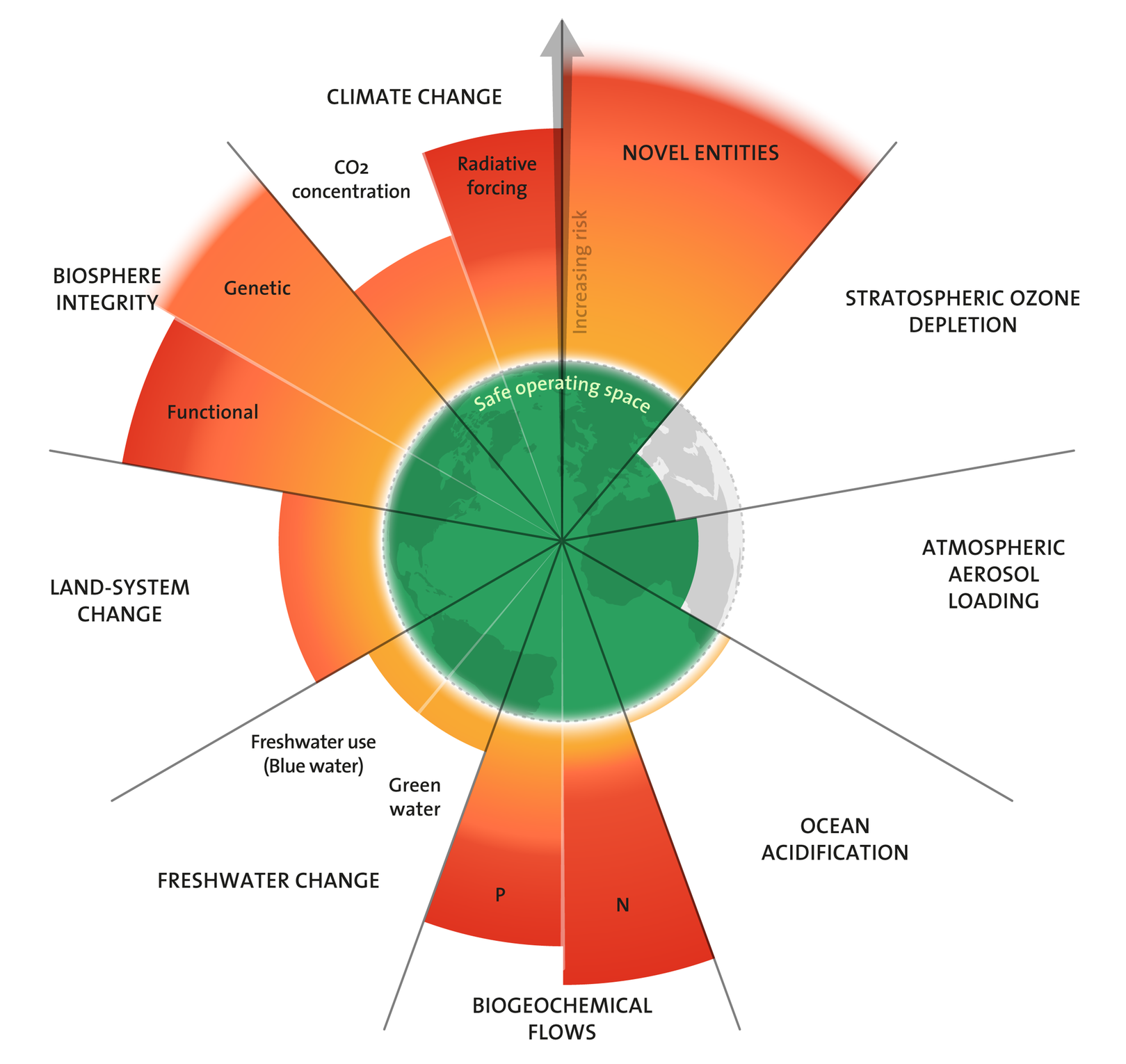
The 2025 Planetary Boundaries Health Check7 is frankly terrifying. We aren’t just failing on climate; we’re into the red almost across the board. Out of the nine boundaries that keep the planet habitable, we’ve already smashed through seven. Everything from the collapse of insect populations to the mountains of plastic and chemicals we’ve dumped into the food chain. We must ground our strategy in the physical reality of a dying Holocene.
These aren’t just ’environmental issues’; they are collective governance failures. No current institution has the authority to make the choices that physics and biology now demand for planet Earth. This is why European strategic autonomy is not an exercise in regional pride—it is the preservation of the only institutional architecture capable of modelling the ‘federation of federations’ we need to escape civilisational collapse.
 The 2025 update to the Planetary boundaries.Licensed under CC BY-NC-ND 3.0. Credit: “Azote for Stockholm Resilience Centre, based on analysis in Sakschewski and Caesar et al. 2025”.
The planetary boundaries are not an ESG talking point. The planetary boundaries define the safe operating space for human civilisation - the conditions within which Holocene stability that enabled agriculture, cities, and complex society exists.8 This is the Holocene sweet spot that allowed us to move from hunting and gathering to agriculture, cities, law, and everything we call history. Breaching seven of them simultaneously does not mean immediate collapse but it means the system is operating outside of parameters within which human civilisation developed, and beyond which non-linear, self-reinforcing cascade (domino) effects and tipping points become increasingly probable.9 We are leaving our children a desperate and degraded future.
“We are witnessing widespread decline in the health of our planet. But this is not inevitable. Failure is a choice. “
(Johan Rockström)
That’s correct, we are choosing our own long-term failure as a species. Planetary boundary breaches are failures of collective action on a global scale. They happen because no institution has the ability to make and enforce the path that physics and biology tell us are required to protect all of us and many other complex species on Earth.
The European Leadership Network’s NEVER report identifies four categories of existential risk whose intersections are the real danger: nuclear catastrophe, climate breakdown, biological threats, and artificial intelligence.10 These are obviously not unrelated independent risks. Nuclear war causes nuclear winter which accelerates climate breakdown. Climate breakdown increases pandemic risk through habitat disruption. AI accelerates all four simultaneously by compressing decision cycles, lowering the technical barrier to engineered pathogens, and enabling autonomous weapons systems that operate faster than human intervention or supervision.
_” Multipolarity without multilateralism — transnational threats are becoming more difficult to manage. A vacuum in global governance is building."_11
(WEF’s 2026 Global Risks Report )
JPMorgan’s geopolitical analysis reaches the same conclusion: climate change, global health, cybersecurity, nuclear non-proliferation, and AI governance require structured cooperation frameworks with agreed metrics, inspection rights, and enforcement mechanisms. Such mechanisms are absent today, leaving systemic risks under-governed as the need for them grows.12
Toby Ord, in _The Precipice_13, estimates the probability of existential catastrophe this century at approximately one in six under current international structures.
The question is : can planet Earth remain habitable for humans without something that functions like a world government in these specific domains?
In the short term: probably yes, with increasing costs. In the medium term: probably not without governance architecture in at least four domains. In the long term: certainly not.
The compounding risks from climate breakdown, engineered pathogens, autonomous weapons, and potentially misaligned artificial general intelligence creates a landscape in which civilisational collapse over a century-long period approaches near certainty without collective world governance mechanisms.
The ozone layer catastrophe showed that we can reverse decline. The Montreal Protocol is the only international environmental agreement that has reversed a planetary boundary breach and it did with trade sanctions against non-parties, making defection costly enough that universal compliance became the rational choice (rather than allowing a Prisoner’s Dilemma game14 where everyone’s individual rational choice is worse for all collectively). This is the ‘Brussels Effect’ applied to human survival, using market leverage to force global change. European strategic autonomy is about preserving a culture that understands why we need to build a world where agreed rules matter.
Planetary wide problems are solvable, not solving them is a choice.
This is the context within which this article must be read and understood. Developing and maintaining European strategic autonomy and geopolitical stability within a bipolar world order is not merely regional self-interest or European civilisational pride. At this specific moment in history, it is about whether the institutional architecture, as pioneered by Europe, that makes adequate global governance eventually achievable is preserved and whether European can rally its allies around the world through this current period of maximum danger – or whether the EU is dismantled, piece by piece, by the combination of American geopolitical interests and aggression and Chinese strategic capture or dominance.
The article makes clear the folly of European appeasement to an American administration that is indistinguishable from a large network of overlapping criminal enterprises.
Europe must learn to play the game its own way, in the space between superpowers. We must learn to monopolise possession of the high ground and the narrative, of leadership in regulation and coordination of the middle powers around the world (Brazil, Canada, Mexico etc.) working the relationships with China and the US with maximum ambiguity for European interests and to make the world safer for the other middle powers and other countries too.
In short, Europe must follow the Spanish way of football and play geopolitical tiki-taka. If the US and China are playing ’long-ball’ geopolitics—relying on high-impact, extractive strikes like unilateral tariffs and security coercion Europe needs to master a high-speed defensive system aimed at denying both superpowers possession and control of the global agenda.
“No to war…[Spain] will not be complicit in something that is bad for the world – and that is also contrary to our values and interests – simply out of fear of reprisals"15
(Pedro Sanchez)
The Physics of Stability
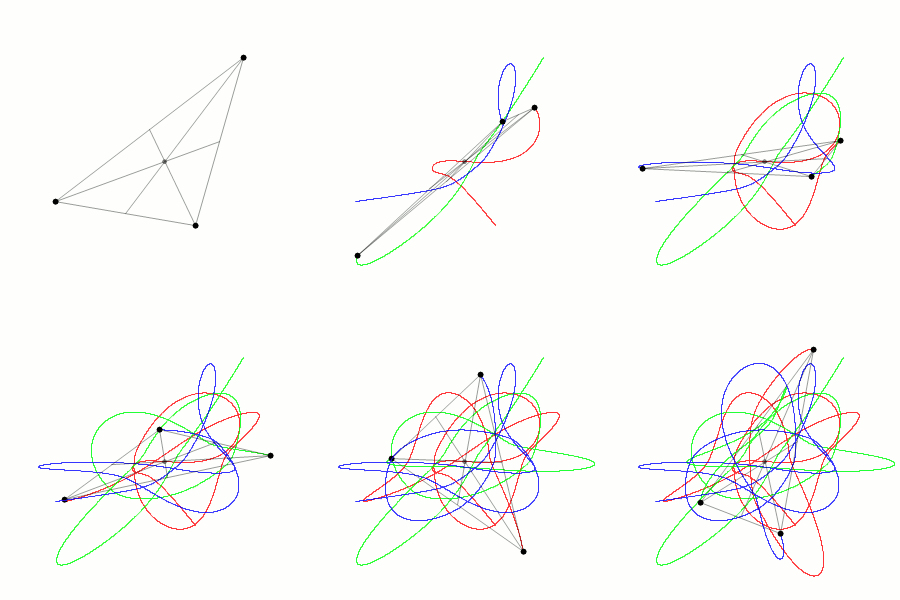
Geopolitics has moved from the stable terror of the Cold War into the intrinsic chaos of the three-body problem. Henri Poincaré proved in 1887 that the motion of three mutually gravitating bodies cannot be solved analytically—it is fundamentally unstable.16 In the physics of power, three-body systems almost always resolve the same way with two dominant masses locked into a stable binary orbit, and the third is violently ejected. Europe is that third body.
 By Dnttllthmmnm - Own work, CC BY-SA 4.0, https://commons.wikimedia.org/w/index.php?curid=59538221
US-China-Russia is currently that system from a force perspective. The binary is already forming — a US-China confrontation becoming the organising principle of 21st-century geopolitics, with Russia increasingly captured by Chinese gravitational pull as sanctions and isolation deepen the Moscow-Beijing dependency. The EU Institute for Security Studies’ September 2025 analysis17 documents that the US-China binary is no longer a future threat; it is the system’s new organising principle. We are witnessing the gravitational capture of Russia by China - a process accelerated by Western sanctions that have left Moscow with no leverage and no alternative partner. Beijing is consolidating its role as the senior partner by absorbing the Russian market on its own terms. Russia has been stripped of its agency and it is now geopolitical mass added to China to increase its global power.
“The rational objective for Europe is not to ‘split’ Beijing and Moscow — their security and diplomatic ties are too binding — but to force a shift in their economic relationship by imposing costs on China.”
(EU Institute for Security Studies)
History confirms that tripolar systems are not merely unstable — they are, by a significant margin, the most dangerous configuration for an international order. The Central European Journal of International Studies concluded in 202418 that tripolarity is more prone to devastating great power wars than either bipolarity or multipolarity because each power must deter two rivals simultaneously, arms control becomes a structural impossibility and when any one of the powers (poles) weaken, the other two race to prey on it, accelerating rather than stabilising the system.
The instability of the tripolar structure is confirmed on a personal level too: both Roman Triumvirates — Caesar, Pompey, and Crassus and then Octavian, Antony, and Lepidus — resolved to a binary confrontation and civil war.
China’s Three Kingdoms period - Wei, Wu, and Shu - maintained a three-body equilibrium for sixty years only through constant active management of a two-against-one coalition, before resolving into binary and then unification. Riker’s game-theoretic size principle19 provides the formal proof for these transitional phases that mirror the physics of the three body problem: in any three-power competition, two bodies always find it rational to ally against the third, forming the minimum winning coalition, then dissolving it once the third is defeated.
A tripolar system with the EU, China and US as the superpowers is therefore not a stable system nor should it be the goal of European in its aim to build geopolitical strength and autonomy. It is a short term transitional configuration at best. In any event, the US-China binary system is already the de facto world geopolitical system. Russia is being absorbed into China and the US is trying to force a weak and divided Europe to remain its vassal.
The question for Europe is therefore how to position itself in a stable orbit between the two great superpowers and use that position for maximum leverage for its own objectives and to achieve longer term goals which align with a safer planet for complex life and a more stable world for all humans.
If Europe succeeds in detaching itself from US foreign policy and control and creating its own orbit between US and Chinese interests, this will help us move towards a stable multi-polar world order as a precursor for a world union (or federation of governments) that is not dominated by just a few players with all of the risks that entails.
Part 2:
The Reckoning: A European Strategy For an Unstable World (Part 2)
Footnotes
These articles are created with the Assistance of AI tools including Claude, Gemini and Notebooklm.
- For historical patterns of US ambivalence toward European integration and the structural logic of transatlantic dependency, see the Foreign Policy Centre’s analysis of how successive US administrations have instrumentalised NATO to limit European strategic autonomy. Foreign Policy Centre, Patterns of History in Transatlantic Relations (2025). ↩︎
- The declassified record of Kissinger’s secret July 1971 Beijing visit — the operational foundation for Nixon’s China opening — is held at the National Security Archive, George Washington University. The documents confirm that the initiative was driven overwhelmingly by the Soviet threat calculus rather than any change in US assessment of Chinese values or governance. National Security Archive, The Beijing-Washington Back-Channel and Henry Kissinger’s Secret Trip to China, 1970–71, NSAEBB No. 66. ↩︎
- The Lagrange point is a precise gravitational concept: the five positions in an orbital configuration where a small object, affected only by gravity, can maintain a stable position relative to two larger bodies. L4 and L5 are the positions of genuine stable equilibrium. The metaphor used throughout this series refers specifically to the diplomatic equivalent: the position from which a third actor can maintain credible uncertainty about its alignment toward both dominant powers. See: Wikipedia, Lagrange Point , with references to the original work of Joseph-Louis Lagrange (1772). ↩︎
- On Beijing’s systematic dismantling of Uyghur cultural institutions, language rights, and religious practices in Xinjiang — described by the UN High Commissioner for Human Rights as potentially constituting crimes against humanity — see: BBC News, China ’s Crackdown in Xinjiang (2025). The parallel with Soviet-era Russification policies is inexact but instructive. ↩︎
- The full text of President von der Leyen’s address to EU ambassadors on 8 March 2026, in which she identified the “existential questions” facing the rules-based order while declining to specify Europe’s response, is available at: European Commission, Speech by President von der Leyen at the EU Ambassadors Conference , Brussels, 8 March 2026. ↩︎
- EU High Representative Kaja Kallas delivered the Churchill Lecture in Zurich on 5 March 2026, explicitly framing the contest between rules-based order and great power predation as the defining challenge of the era. The text of the lecture represents the clearest statement of European strategic intent published by a senior EU official in the current cycle. European External Action Service, 2026 Churchill Lecture:‘The Rules-Based Global Order in an Era of Power Politics’, Zurich, 5 March 2026. ↩︎
- The Stockholm Resilience Centre’s Planetary Health Check (November 2025) confirmed that seven of nine planetary boundaries — the thresholds defining the safe operating space for human civilisation — have now been breached. The boundaries in question are climate change, biosphere integrity, land system change, freshwater use, biogeochemical flows, novel entities (including synthetic chemicals and microplastics), and ocean acidification. Stockholm Resilience Centre, Planetary Health Check 2025 (November 2025). ↩︎
- The original planetary boundaries framework was published in Science in 2015, establishing the nine Earth-system processes and their quantified thresholds. The framework has since become the standard reference point for assessing civilisational risk from environmental change. Steffen, W. et al., ‘Planetary Boundaries: Guiding Human Development on a Changing Planet’, Science , Vol. 347, No. 6223 (February 2015) ↩︎
- On the non-linear cascade and tipping point dynamics that become increasingly probable as multiple planetary boundaries are breached simultaneously — including the risk of self-reinforcing feedback loops that can carry the Earth system to a “Hothouse Earth” state regardless of subsequent human emissions reductions — see: Lenton, T.M. et al., Tipping Elements in Earth’s Climate System, Proceedings of the National Academy of Sciences (2008), available through NERC Open Research Archive. ↩︎
- The European Leadership Network’s NEVER report (No Existential Risk Verification and Elimination) identifies four categories of existential risk — nuclear catastrophe, climate breakdown, biological threats, and AI — and argues for new governance architecture to manage their intersection. The report is the most practically detailed roadmap currently available for European contributions to global existential risk reduction. European Leadership Network, How to Save the World: Influencing Policy on the Biggest Risks to Humanity (2025). ↩︎
- The World Economic Forum’s Global Risks Report 2026 identifies environmental and technological systemic risks as the top long-term threats to global stability, with climate-related risks occupying four of the top five positions over a ten-year horizon. World Economic Forum, Global Risks Report 2026 (January 2026). ↩︎
- JPMorgan’s Centre for Geopolitics analysis identifies the governance deficit in climate, health, cybersecurity, nuclear non-proliferation, and AI as the defining structural vulnerability of the current international system — a vulnerability that compounds as institutional cooperation frameworks erode. JPMorgan Chase, A World Rewired: Geopolitics and the New Global Order (2025). ↩︎
- Toby Ord, philosopher at the Future of Humanity Institute, Oxford, estimates the probability of existential or civilisational catastrophe this century at approximately one in six under current international governance structures — a figure he derives from independent probability assessments of nuclear war, engineered pandemics, misaligned AI, and climate breakdown combined. Toby Ord, The Precipice: Existential Risk and the Future of Humanity (Bloomsbury, 2020). ↩︎
- The Prisoner’s Dilemma is the game-theoretic model in which individually rational decisions by independent actors produce collectively irrational outcomes — the formal structure underlying most collective action failures in international relations, from arms races to climate negotiations. For a detailed exposition in the context of inequality and resource governance, see the author’s earlier essay on this blog: Inequality and Inequity (March 2024). ↩︎
- Spanish Prime Minister Pedro Sánchez’s explicit rejection of US-led military action against Iran in March 2026 — and his broader articulation of a European foreign policy doctrine centred on international law rather than great power alignment — represented the clearest statement of what a Lagrange-point European posture looks like in practice. CNN, Spain’s Sánchez Rejects Trump’s Iran War Stance (8 March 2026). ↩︎
- In 1887, Henri Poincaré demonstrated that the motion of three mutually gravitating bodies cannot be solved by any closed analytical formula — a finding that won the King Oscar II Prize and founded modern chaos theory. The implication is that three-body systems are intrinsically unpredictable over long time horizons and tend to resolve into binary configurations as one body is ejected. For the mathematical and historical context, see: Wikipedia, Poincaré and the Three-Body Problem , with references to Poincaré’s original Acta Mathematica papers. ↩︎
- The EU Institute for Security Studies’ September 2025 analysis documents in detail how Russia’s economic dependence on China has deepened since 2022 sanctions, with Beijing now acting as senior partner and Moscow locked into the relationship without reciprocal leverage. The paper is the most rigorous current assessment of the Russia-China nexus and its implications for European security. EUISS, The Dependence Gap: Russia-China Relations and European Security (September 2025). ↩︎
- The Central European Journal of International Studies’ 2024 analysis provides the most recent formal treatment of tripolarity’s instability, concluding that three-pole configurations are more prone to devastating great power wars than either bipolarity or multipolarity — primarily because each power must deter two others simultaneously, making arms control structurally harder. CEJISS, Vol. 18, No. 2 (2024). ↩︎
- William Riker’s size principle — formally derived in The Theory of Political Coalitions (1962) — holds that in any competitive multi-actor system, rational actors will always form the minimum winning coalition rather than a larger one, since adding unnecessary members dilutes the rewards of victory. The principle provides the formal game-theoretic basis for why three-body systems resolve into binary confrontation. William H. Riker, The Theory of Political Coalitions (Yale University Press, 1962). ↩︎